06 December 2012
Composite Characters
I'm going to be reblogging the posts from my blog tour earlier this past October, just in case anyone missed them in their original locations. They discuss writing generally, but are all tied back into Rmnce, my most recent release which tells a story of new love through the text messages and letters between characters.
A.M Jenner is the author of the Sci-Fi book Assignment to Earth, and hosted my post on composite characters. If you didn't catch it there, here it is!
They say that creating characters from real people lies at the vertex of laziness and subliteracy. And when I say “they,” I mean the Bitchy Goblins That Live in my Head. Yet at the same time, a composite of a dozen people becomes more than the sum of its parts, or else less than the sum of its parts. In either case, there is art in it, beauty of an open and apparent kind. More over, in an attempt to capture the mind of a generation, it pays to take a few pieces from the individual, as well as from the collective.
Britney Morgan, the female lead of Rmnce, is one of those characters. She combines a sequence of men and women whose mannerisms were unique enough to remain steadfastly in my mind, some of them for years past our parting, whose tendencies and paradigms were both a product and a mockery of those people. The irony in this is that the character came out decidedly unlikable. She demonstrates the point of the work as well as I could ever hope for, serving her purpose flawlessly and without alteration.
Yet she exists in my mind, a personality which I could almost put in place of my own were I to choose, and perhaps part of the reason she eats at me like a Herculean poison is that she exists as an unnatural aberration, a creature of a certain sort of beauty which nonetheless simply ought not be.
Beauty in all things. So chew on that, Bitch-Goblins.

29 November 2012
Art is Pain
I'm going to be reblogging the posts from my blog tour earlier this past October, just in case anyone missed them in their original locations. They discuss writing generally, but are all tied back into Rmnce, my most recent release which tells a story of new love through the text messages and letters between characters.
The
opening post of my blog tour for Rmnce was hosted by the sci-fi author Len
Berry, who published the dystopian novel Vitamin F this summer. The tour begins with an age old question.
29th September – What is Art. Hosted
by Len Berry.
Art is Pain
They say art is pain. They say the same
thing of love and beauty, and while these sorts of platitudes are the written
equivalent of drunken regret the parallel has a bit of validity. Art IS pain,
it is very much the emptying of a tortured soul onto a page, a canvass, or a
stage. And what more ubiquitous and artful agony is there than that of romantic
love? It is the defining pain of human existence, a fragile and tempestuous
emotion; it builds on itself exponentially until it either reaches a sort of
Singularity, a critical mass which alters its form subtly into a force harder
than steel, or else collapses under its own weight like a star with the tiniest
bit too much mass.
Thus, one will often find that a great
writer (painter, actor, musician) will have behind them a tumultuous and nearly
self-destructive romantic history. After all, if art is pain, more pain would,
it stands to reason, tend to produce more art, whether in the sense of pure
mass of production or greater concentration. However, what one has to ask
oneself is, do artists become artists because their history of disfiguring
romantic entanglements gives them the inspiration to do so, or is the artistic
temperament simply prone to the sort of emotional extremes which produce the
romances which burn twice as hot and half as long?
10 August 2012
Fuck Your Ending; Or, Why You Musn’t Ever Matter Except if There's a Lot of You and Even Then Only Sort Of
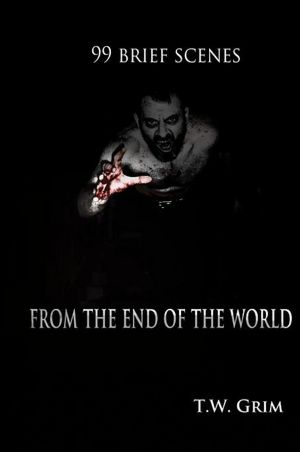
First, though, I want to do a brief review of the book, because it's my party and I'll review if I want to. Review if I want to.
99 Brief Scenes From the End of the World (henceforth 99S) is,
and believe me when I say that I don’t use this term lightly or regularly,
absolutely brilliant. It combines a technique which I've never seen before,
writing 99 stories each several pages in length, with a nearly breathless but
nonetheless well-paced tone. I know I’m
supposed to be in superlative rehab, but I'm jumping off the wagon with both feet because it really is the best thriller I’ve
ever read and in my top 5 books written within my
lifetime. It is also very possibly the most blatant and uncompromising look at
the beauty which lies in ignoring the reader.
Read it, and if you don’t love it quit reading and take up
another hobby because you are clearly just plain not fucking cut out for it.
As for the cultural context, the Not Review portion of this
post, 99S was originally written as a serial on Reddit, a site which is
something like a sequel to that far more famous, or perhaps infamous, hive of
scum and villainy, fiction and falsehood from the olden days of the web. What
that means, for Reddit that is, is that despite its toothless debility it is still in many ways a microcosm of internet culture, a mirror of
the inherent nature of a people which hide at the bedrock center of hundreds of
web communities, providing us with everything from lolcats and trollception to unbounded intellectual inquiry and sociopolitical activism.
99S embodies that same mindset: Digressive, irreverent,
almost combatively uninterested in the comfort of anyone, anywhere; in short, all
that the web is at its best and its worst, with nothing in between. It is a
book which could not exist without untold millions of 1’s and 0’s and the
culture they spawned. The beauty in this is that, unless I miss my guess, the occurrence is entirely unintentional. The book isn’t about the internet, doesn’t say a single word directly about
internet culture; it was simply birthed by a creator possessed
of, or perhaps possessed by, a cultural phenomenon beyond his control.
As writers we are in no way immune to the influences of
culture. Those of us whose egotism is exceeded only by our single-minded
dedication to a goal very nearly unattainable often like to pretend that we
exist in a world unto ourselves, somewhere between a fantasy and a vacuum, but at the risk of disabusing some pleasant notions, no man is island. I would go so far as
to say that we who fancy ourselves artists are more so mirrors of the time and place in which we live,
inadvertently exposing our cultural heritage for the viewing public in a way
which is inextricable not just from the self but also from the collective. From
what some might call the collective unconscious, the zeit- or volksgeist, or if they're dumb and whining at me (as is the wont of so many), the esprit d'corps.
The question, then, is how much is a work truly ours, as writers? Does the fact that we are often
channeling some unseen force, drawing our story not entirely from ourselves but
from the world we live in mean that in some way the work is the property of that collective unconscious? This is not a
rhetorical question.
As an extension of all this, we must face the topic which has occupied my mind for what would be fairly described as an embarrassing amount of time if I was capable of embarrassment; I am consumed by curiosity as to what the literary analysts will (or would...) find in
my work, what voices enter unbidden...
So, I’ll issue this challenge, through not a spirit of
generosity I’ve never possessed but rather in pursuit of what only you may give
me, my dear readers:
If you fancy yourself a literary sort, the sort of person
who finds things the author cannot, email me and I’ll have a PDF of
anything published in your hands in hours, God willing, with the sincere
hope that you will return to me a work of sublime insight somewhere between 1
sentence and a graduate thesis.
In the meantime, abandon your thoughts of my work, and bury
yourself in Mr. Grim’s. It is, in a word, unapologetic, reveling carelessly in a
quagmire of the sort of guiltless imperfection which stands in stark contrast
to self-conscious literary vanity, a
paragon of the nearly imperceptible.
I didn’t care for the ending, but you know what? Fuck my
ending. And fuck yours, too. Genius answers to no one, or in failing to abandons
itself to the mob.
03 August 2012
Seek Bliss You Self-Important Tit; Or, Popcorn is Good, Too.

This Not Review is about a freebie I stumbled across on
Amazon, a book called Clockwork Blue that if I’m being honest I wouldn’t
have picked up if it hadn’t been free. It’s an alternate history fantasy romance
about the intervention of pixies in the Napoleonic Wars, or more accurately in
the time leading up to the Napoleonic Wars. Or not leading up to them, if the fairies win. I don't know. Didn't finish it. Sorry dearest Gloria... you're in the 99%.
Think of this post as the inversion of my Pride and Prejudice and Zombies post; that is to say, a post about how things that aren't art can still be good.
What I want to write about today, if you haven't picked up on it, perhaps because you were distracted by the brilliance of that Not Review I linked above, is this: that of shallow, mindless storytelling.
Now, reading that, you are probably becoming whiney and
outraged, if you’re the sort of reader who should really sort themselves the
fuck out like seriously, complaining that it’s unfair for me to look down on a
work simply because it doesn’t adhere to my standard of what a book ought to
be. Perhaps you’re even attempting to draw a parallel to the ‘artificial’
standards of beauty, if that happens to be your cause (as it seems to be for an
anomalous number of my readers). However, this is not the case. Or at least,
not entirely.
Some of you may recall, a while ago I wrote a brief treatise on G+ about the popularity of meaningless pop music. My approach to it was
deemed artistic elitism and inspired a bit of ire, and if you were the sort who
had that impression of it, prepare for a sense of déjà vu.
That question with regard to music, the question of why
meaningless, musically questionable pop music continues to top the charts as it
has for as long as charts have been a thing, has long been, and perhaps still
is, a source of no minor bafflement in many of my correspondents. It is my
suspicion that the same question may arise with regard to literature, so I’m
going to address it. To summarize my previous work, what one must keep in mind
is that not everyone goes to music in order to be altered as a person. Often
they go to it to be entertained. This is also true of literature, perhaps even
more so since ‘deep’ literature tends to be a little tiny bit
Clockwork Blue is what Yahtzee Croshaw might call a popcorn book; a
little bit of fluff which serves to distract us from the mind-numbing tedium
which makes up the average human lifespan (not mine, of course, because I’m an
international man of mystery, but work with me here). It isn’t very
substantial, and I can almost guarantee it won’t change your perspectives on a
goddamn thing, but it nonetheless serves a purpose, perhaps an important
purpose, in the lives of its readers, and indeed in the world of literature as
a whole.
While it’s important to continue to expand our minds and
seek experiences which shake the foundations of our identity, it’s also
important to embrace bliss, and bliss comes in many forms, not the least of
which is the simplistic, the subliterate, the quietly pleasant and unassumingly
enjoyable.
The moral of this story is that you musn't allow your pretention to override your pursuit of
pleasure.
12 July 2012
Guest Post by JD Savage: Writing for the Market, or Just for You
Today we have a guest post from fantasy writer JD Savage, one of my fellow Literary+ luminaries whose new book "The Seeds" has just been released. He's talking about something many authors face; the question of whether writing, which like so many forms of expression is both an art and (for a lucky few) an industry, should be a product not only of inspiration but also capitalist necessity.
 Writing for the Market

Writing for the Market
-Or Just for You?
Some of the authors that will be published in the wake of such a juggernaut have been writing and seeking a publishing home for years before such a thing happens. They find themselves in the right place at the right time, and boom! They get their sparkly vampire love triangle story published. Good on them. Others see the trend coming, craft a story that fits the genre, work really hard to polish it and make it a good book, and they get published, as well. Then they are doomed to an endless sea of comparisons to a book or series that may be less polished but more accepted by the reading public.
We should all be so lucky.
In the midst of this, writers are faced with choices. If they have a relationship with a publishing house, they may be under pressure to follow the latest trend. Or, they may be feeling the pressure from their own fans, clamoring for a similar story written in their style. What trends are coming, ready to be seized?
There are plenty of blogs out there that track these sorts of things. The Hub, has a list of trending topics that are beginning to emerge in YA literature, (my personal favorite, young girls that know how to kill). I have no personal connection to this site, I just thought they provided a pretty balanced list. If you are looking to make a living as an author, it may be that capitalizing on an upcoming trend is the way to go.
But, before you go and write the next happy-go-lucky dystopian shoot-em-up, consider this. Somebody started those trends. Some author wrote something that was still done in a unique way. Maybe it wasn’t wholly original, (is there such a thing?), but eye-opening, nonetheless. It was cool enough to garner a bunch of readers, get people talking about it, and be interesting enough to start a trend.
When you first sat down to write, is that what you wanted? Did you want to take the world by storm with your unique viewpoint? Or, did you hope to be the voice in the crowd who rises above the din, doing what everyone else is doing, only doing it better?
There’s no right and wrong here. Oh, to be sure, some will sniff haughtily at the trends and think themselves too artistic for all of that. But writers, in general, are not wickedly interested in seeing you fail. Success is hard to come by, and whether you walk the well-worn path or blaze your own, most writers, (avid readers, all), will applaud your efforts.
So, the choice is yours. Read up on the trends, pick one, (or two or three…), and make it your own. Or, tell that unique story you want to tell, make it great and keep at it. The really prolific might even try to do both. Whichever path you choose, remember that you can do it. You can be the one that tells that story in the way that the public needs to hear it. You can write just for you, and people may fall in love with your voice, your style - whether you writing a time-honored tale or something totally personal.
I plan to keep writing books I want to read. If I like it, that’s a success for me. That’s the choice I’m making. Although a story about young female assassins may not be so far out of my comfort zone…
What do you think of Katniss as a character name? … Too soon?
About The Seeds and its author:
This is not your grandmother's fairy tale. A fantasy novel that turns the genre on its head, "The Seeds" follows Trooper Angus Mayweather as he is thrust into the conflict faced by twin sisters Dartura & Varia, Generals of the Tarol Nation. As the sisters uncover a new threat from an old enemy, Angus must do what he can to help as the Tarol Nation faces all-out war.
Links:
Where to buy: "The Seeds"
Website: www.jdsavage.com
Writer's Blog: Tarol Nation
G+ profile: JD Savage
13 April 2012
A Fresh Assault on Literature: Mastercard Steps into PayPal's Shoes
As you (almost certainly don’t) know, I have a strange love of patterns. Not the sort of patterns which are stable and predictable, patterns which leap around while maintaining a central theme, graffiti-esque amalgamations of ideas and emotions tied together only in the abstract. This post will break a pattern of beautiful and artistic narcissism on my part, but it will do it because I must once again make a stand in hopes of breaking a very different sort of pattern.
Over the past several months, we’ve had one attack on our freedom of expression after another, a string of violations as gratuitous as they are invasive. Some, like SOPA, are governmental in nature, broad stroke assaults under the guise of piracy or something equally hot button and gimmicky. These have received attention on a large scale, so we shall move briskly past them. What hasn’t, and what is worse in its way, is the economic strangulation of ‘objectionable’ writing.
I’ve spoken vehemently and repeatedly of this on G+, many comment sections, and of course the inimitable meatspace, but apart from my Lockpick Pornography post have not done so here. A new instance of it has sprung up, though, giving me both an opportunity and an obligation to do so.
Mastercard has in the past few days decided that they wish to strangle erotic content which covers ground they do not wish to see explored. They are doing so by refusing to process payments for any online outlet which allows content they dislike, and their position in the market allows them to make great strides in assaulting our freedom.
This is not the first time, but it is my hope that a show of grassroots force will mean it is the last, or at least the last for a while. PayPal, as many of you know, did something similar in the past, a policy activists like me fought back against and saw overturned. However, where PayPal did it through the banning of broad themes, Mastercard has taken a rather more Orwellian approach by banning specific words outright. Below appears the list:
Alcohol, drink, liquor etc.
Asphyxia, asphyxiate, asphyxiation etc.
Beastiality
Bestiality
Bled, Bleed, Bleeding etc
Blood
Brutality
Brutalization
Child
Chloroform
Drugged, Drug
Drunk
Force, Forcing etc
Hypnosis
Hypnotize, hypnotise etc
Incapacitate, Incapacitation etc
Incest
Infant
Intoxicate, intoxication etc
Kidnap
Lactate and variants
Menstrual, menstruate etc
Molest, molestation, molested etc
Murder (and variations)
Mutlilate, Mutilation etc
Necrophilia
Passed out
Pedophilia (and various alternate spellings)
Piss
Rape, raping, rapist etc
Scat, shit, fecal, bukake etc
Fetal, foetal etc
Sedate, sedative sedation etc
Sleep, slumber
Smother, snuff
Tentacle
Torture
Unconscious
Underage
Unwilling
Violate, violating etc
Now, what many of you are thinking is, “That stuff sounds fucking terrible… maybe Mastercard is doing the world a favor.” Now, yes, much of it sounds terrible (though, menstruate?), but the thing about it is that this is art. Erotica is art, and as art it must of necessity be unrestrained, must be able to deal with themes which are unpleasant, even sickening, in order to do it’s job.
If you doubt that, look to the Dirty Minds vs. Debit Cards series which Eden Connor curated on her blog during the PayPal incident. It shows that the writing and reading of such material has tremendous potential to aid in healing for those who have experienced these things in the worst possible way. The stories you find there are those of people whose lives have been directly and measurably improved by this material – for someone like Mastercard to deny that to the web is repugnant in the extreme.
Yet this is not truly relevant. Even if this material had no potential to heal, no artistic merit, no reason to exist whatsoever, the fact of the matter is that this work harms no one, indeed effectively does not exist for anyone who does not actively choose to seek it out and engage with it. There is no reason for Mastercard, PayPal, or anyone else whatsoever to be indulging their own narrow morality by attacking it.
Now, those of you who have read my work are perhaps wondering why I feel this is my fight. After all, my content is not erotic in nature, and while some of these words do appear in my work, the fact that it is not erotica will likely spare me Mastercard’s wrath. In short, you are noting that I have no immediate dog in this fight.
In answer to that unspoken question, I’m here because we as writers have a transcendent right to sell our work, to share it with those who want it or need it, to bring light to the abysmal darkness which is the human experience with the products of our minds. With that right comes an overriding responsibility to defend that right not only for ourselves and our readers but for all artists, all consumers, all mankind everywhere. It is my sincere hope that this message will inspire you to act, to spread this message and those like it to all those lovers of art in its myriad forms such that we may continue to show the corporate puppeteers who dream themselves our overlords that we will not and cannot stand idly by while they enforce themselves on those who seek freedom.
The contact information for Mastercard may be found on their website below:
https://www.mastercard.com/us/personal/en/general/contact-us.html
If you have any more information on this issue, better contact information for Mastercard, petitions or open letters to sign, or even if you just want someone to rant to about all of this, by all means email me.
03 April 2012
Derivative Bullshit, Emphasis on the Bullshit; Or, Why Horrible Things Can Still Be Art
 |
| Image Source: www.collider.com |
This is Not a Review… mostly. But in order to make my point I’m
going to have to do a little reviewing. If you are a NaRB purist, I will
understand if you choose to wait until next Tuesday to find another Not Review.
Today’s book is not a good book. It’s barely a decent book. In fact, it
perpetuates the single worst trend in the modern era. I’m talking about Pride and Prejudice and Zombies by Seth
Grahame-Smith. What it is, however, apart from a shit Popsicle, is an object
lesson in the power of derivative works.
For those of you who don’t read things written in the past
50 years, and who could blame you, Pride
and Prejudice and Zombies is Austen’s Pride
and Prejudice except with… zombies. Now, those of you who have followed my
work closely already know that I consider zombies the single worst
fantasy/sci-fi monster in the entire world. In fact, I’m going to go on record,
at hazard of reputation, as saying that never at any time in the past, present,
or future has there been or will there be a worse monster than the zombie, or
indeed a worse character of any kind. They’re boring, pointless, not scary in
any way, and have no legitimate message to convey whatsoever.
However, they are emblematic of all that’s wrong with modern
fiction; to wit, idiotic pandering to a demographic which, in a just world,
wouldn’t exist in the first place, a demographic which a cursory genealogical
study would demonstrate serves only to drag down the human race into a
festering cesspool of incest and genetic degredation, a demographic which is so
utterly without merit that its survival instinct has been subverted by the
perverse desire to be cannibalized by the resurrected corpses of its betters,
nature having turned against her own in sheer madness at the consistent failure
of evolution which marks their reproduction. Yet the fact remains that in doing
so it accomplishes something that very little else has. By juxtaposing the
Victorian culture espoused so beautifully (if interminably) by Miss Austen with
the far more modern (Don’t link me to zombie texts from the 1800s that wasn’t
the same and you fucking know it) concept of zombies and pseudo-Eastern martial
arts, and continuing to explore the themes of womanhood and feminism as Austen
herself did only taken much further in accordance with modern concepts of them,
Grahame-Smith created a true work of art. It demonstrates the shifts in
society, both positive and negative, setting the beauty of history alongside
the freedom of modernity and standing back with its arms crossed daring anyone
to see past its façade of childishness to the artistic core within.
This teaches us two things. The first is that allowing
derivative works has a tremendous potential to advance art without undermining
the original (after all, I seriously doubt people have quit buying Pride and Prejudice in favor of Seth
Grahame-Smith’s fetid tome). This leads us to a copyright debate which I won’t
launch into except to say that there is a difference between allowing someone
else to create something new from the work of a dead author and allowing anyone
to publish the work of whomever because fuck people who want to make money off
their work.
The second is that a book doesn’t have to be good to be art. It doesn’t have to be
enjoyable or well-written, it merely has to convey a message beyond the
obvious, and Pride and Prejudice and
Zombies does so in stunning(ly shitty) fashion.
Subscribe to:
Posts (Atom)