19 January 2013

Mores Cover Contest

Question.jpgIt's time for another cover, and another cover contest! Mores is in need of your help, and I have 150 reasons for you to come to its aid...

Mores is going to be released in March, and that means its time for the final capstone to be added: The cover. With my Rmnce cover contest having been such an astounding success, it would be foolish to go another direction, now wouldn't it?

That in mind, I'm offering $150, all of my published works, a selection of other books that have served as an inspiration over the years, and of course Mores itself, to whomever can create a cover that embodies what Mores is about and gives it that little push to succeed.

What Mores is, is a pair of tales running in parallel. One is set in prehistoric Ireland, the other in modern New York, two women seeking identity and bliss in wildly different circumstances. A cover should convey this chronological dichotomy and humanistic emphasis. How it does that is up to you. More general information on Mores can be found here.

If you have any questions at all about the book, the contest, the artistic purpose of my existence, or anything else, don't hesitate to email me. The most important thing is that the artistic purpose of your work mirrors or compliments the artistic purpose of mine, so lean towards more questions rather than fewer.

The contest ends March 1st.

General Requirements are as follows:
Digital Format
No Porn (Yes, I know, I’m sorry; I love you, my dear pornographers, but you can’t fight city hall)
Legally yours to sell
Contains the book title and my name

Size requirements are as follows:
>2,500 pixels tall (greater than)
Height 1.6x greater than width
Total file size <5 mb (less than)

Apart from that, let your mind wander. I have utmost faith.

Legal stuff: artists retain full and unconditional rights to any work not chosen; the one I do choose will become my sole property with no expectation of payment or royalty over and above contest prizes. Submitting gives me right of refusal at the prize amount for the duration of the contest + 1 month, or until the contest ends, whichever comes first. I reserve the right to reject all offered covers and select no winner, in which case I will terminate all right of refusal. 

15 December 2012

Dialects of Modernity


I'm going to be reblogging the posts from my blog tour earlier this past October, just in case anyone missed them in their original locations. They discuss writing generally, but are all tied back into Rmnce, my most recent release which tells a story of new love through the text messages and letters between characters.

The third post of the Rmnce blog tour was hosted by the delightful Brooke Johnson. Brooke wrote the steampunk novel The Clockwork Giant.

I have been on both sides of the prescriptionist/descriptionist divide over the years. On the one hand, its undeniably maddening to see things that were patently wrong when you learned the language embraced as the new normal. That being said, in my experience changes to the language tend to be for the better, at least insofar as better is defined as more usable, convenient, and relevant.

The extreme of this, of course, lies in full-fledged dialects. Perhaps 15 years ago America saw a brief push to have Ebonics declared a legal dialect, with the potential for school curriculum to be altered commensurately to both teach it and teach in it. This movement was, as one might imagine, roundly defeated, but it brought up the issue of whether dialects can be considered valid evolutions of the language. Certainly Ebonics has a number of expressions which serve purposes traditional English needs served; this in itself gives validity to the existence and perpetuation of it, no matter what opinion one may have of its general appeal.

By the same token, text speak, the other principle American dialect of our time, also adds to the English language, albeit in a very different way. By taking words and sentences and hyper-simplifying them, condensing them into an utterly optimized form, it sacrifices the structural beauty, and a degree of the expressiveness, in favor of efficiency. The irony, of course, is that the very people for whom efficiency is a nearly overriding concern are those who dismiss text speak as the domain of children and imbeciles.

In evaluating a dialect’s usefulness and hence broad value, one must ask oneself if it adds to the language as it stands, and in most cases dialects which do not simply die out. Any which has stood the test of time must be looked at closely in terms of applicability. Rmnce demonstrates that art and meaning can be carried by this strange new configuration; beyond that threshold nothing more ought be required.


06 December 2012

Composite Characters


I'm going to be reblogging the posts from my blog tour earlier this past October, just in case anyone missed them in their original locations. They discuss writing generally, but are all tied back into Rmnce, my most recent release which tells a story of new love through the text messages and letters between characters.

A.M Jenner is the author of the Sci-Fi book Assignment to Earth, and hosted my post on composite characters. If you didn't catch it there, here it is!


They say that creating characters from real people lies at the vertex of laziness and subliteracy. And when I say “they,” I mean the Bitchy Goblins That Live in my Head. Yet at the same time, a composite of a dozen people becomes more than the sum of its parts, or else less than the sum of its parts. In either case, there is art in it, beauty of an open and apparent kind. More over, in an attempt to capture the mind of a generation, it pays to take a few pieces from the individual, as well as from the collective.

Britney Morgan, the female lead of Rmnce, is one of those characters. She combines a sequence of men and women whose mannerisms were unique enough to remain steadfastly in my mind, some of them for years past our parting, whose tendencies and paradigms were both a product and a mockery of those people. The irony in this is that the character came out decidedly unlikable. She demonstrates the point of the work as well as I could ever hope for, serving her purpose flawlessly and without alteration.

Yet she exists in my mind, a personality which I could almost put in place of my own were I to choose, and perhaps part of the reason she eats at me like a Herculean poison is that she exists as an unnatural aberration, a creature of a certain sort of beauty which nonetheless simply ought not be.

Beauty in all things. So chew on that, Bitch-Goblins.

29 November 2012

Art is Pain


I'm going to be reblogging the posts from my blog tour earlier this past October, just in case anyone missed them in their original locations. They discuss writing generally, but are all tied back into Rmnce, my most recent release which tells a story of new love through the text messages and letters between characters.

The opening post of my blog tour for Rmnce was hosted by the sci-fi author Len Berry, who published the dystopian novel Vitamin F this summer. The tour begins with an age old question.

29th September – What is Art. Hosted by Len Berry.


Art is Pain

They say art is pain. They say the same thing of love and beauty, and while these sorts of platitudes are the written equivalent of drunken regret the parallel has a bit of validity. Art IS pain, it is very much the emptying of a tortured soul onto a page, a canvass, or a stage. And what more ubiquitous and artful agony is there than that of romantic love? It is the defining pain of human existence, a fragile and tempestuous emotion; it builds on itself exponentially until it either reaches a sort of Singularity, a critical mass which alters its form subtly into a force harder than steel, or else collapses under its own weight like a star with the tiniest bit too much mass.

Thus, one will often find that a great writer (painter, actor, musician) will have behind them a tumultuous and nearly self-destructive romantic history. After all, if art is pain, more pain would, it stands to reason, tend to produce more art, whether in the sense of pure mass of production or greater concentration. However, what one has to ask oneself is, do artists become artists because their history of disfiguring romantic entanglements gives them the inspiration to do so, or is the artistic temperament simply prone to the sort of emotional extremes which produce the romances which burn twice as hot and half as long?


10 August 2012

Fuck Your Ending; Or, Why You Musn’t Ever Matter Except if There's a Lot of You and Even Then Only Sort Of

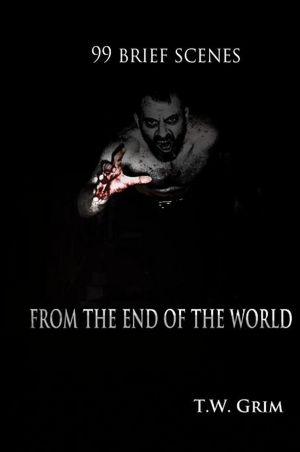
What I want to talk about today is the cultural background, the cultural context of written work, and by extension all art. I'm going to do that through the lens of 99 Brief Scenes From the End of the World, by a man who might just make himself the voice of a generation his bio insists he isn't even part of, one T. W. Grim. (Yes, I'm aware Usenet came about in 1980, Fact Checking Reader Who Lives in my Head. The point stands.)

First, though, I want to do a brief review of the book, because it's my party and I'll review if I want to. Review if I want to. 

99 Brief Scenes From the End of the World (henceforth 99S) is, and believe me when I say that I don’t use this term lightly or regularly, absolutely brilliant. It combines a technique which I've never seen before, writing 99 stories each several pages in length, with a nearly breathless but nonetheless well-paced tone.  I know I’m supposed to be in superlative rehab, but I'm jumping off the wagon with both feet because it really is the best thriller I’ve ever read and in my top 5 books written within my lifetime. It is also very possibly the most blatant and uncompromising look at the beauty which lies in ignoring the reader. 

Read it, and if you don’t love it quit reading and take up another hobby because you are clearly just plain not fucking cut out for it.

As for the cultural context, the Not Review portion of this post, 99S was originally written as a serial on Reddit, a site which is something like a sequel to that far more famous, or perhaps infamous, hive of scum and villainy, fiction and falsehood from the olden days of the web. What that means, for Reddit that is, is that despite its toothless debility it is still in many ways a microcosm of internet culture, a mirror of the inherent nature of a people which hide at the bedrock center of hundreds of web communities, providing us with everything from lolcats and  trollception to unbounded intellectual inquiry and sociopolitical activism.

99S embodies that same mindset: Digressive, irreverent, almost combatively uninterested in the comfort of anyone, anywhere; in short, all that the web is at its best and its worst, with nothing in between. It is a book which could not exist without untold millions of 1’s and 0’s and the culture they spawned. The beauty in this is that, unless I miss my guess, the occurrence is entirely unintentional. The book isn’t about the internet, doesn’t say a single word directly about internet culture; it was simply birthed by a creator possessed of, or perhaps possessed by, a cultural phenomenon beyond his control. 

As writers we are in no way immune to the influences of culture. Those of us whose egotism is exceeded only by our single-minded dedication to a goal very nearly unattainable often like to pretend that we exist in a world unto ourselves, somewhere between a fantasy and a vacuum, but at the risk of disabusing some pleasant notions, no man is island. I would go so far as to say that we who fancy ourselves artists are more so mirrors of the time and place in which we live, inadvertently exposing our cultural heritage for the viewing public in a way which is inextricable not just from the self but also from the collective. From what some might call the collective unconscious, the zeit- or volksgeist, or if they're dumb and whining at me (as is the wont of so many), the esprit d'corps.

The question, then, is how much is a work truly ours, as writers? Does the fact that we are often channeling some unseen force, drawing our story not entirely from ourselves but from the world we live in mean that in some way the work is the property of that collective unconscious? This is not a rhetorical question. 
  
As an extension of all this, we must face the topic which has occupied my mind for what would be fairly described as an embarrassing amount of time if I was capable of embarrassment; I am consumed by curiosity as to what the literary analysts will (or would...) find in my work, what voices enter unbidden...

So, I’ll issue this challenge, through not a spirit of generosity I’ve never possessed but rather in pursuit of what only you may give me, my dear readers:

If you fancy yourself a literary sort, the sort of person who finds things the author cannot, email me and I’ll have a PDF of anything published in your hands in hours, God willing, with the sincere hope that you will return to me a work of sublime insight somewhere between 1 sentence and a graduate thesis.

In the meantime, abandon your thoughts of my work, and bury yourself in Mr. Grim’s. It is, in a word, unapologetic, reveling carelessly in a quagmire of the sort of guiltless imperfection which stands in stark contrast to self-conscious literary vanity, a paragon of the nearly imperceptible.

I didn’t care for the ending, but you know what? Fuck my ending. And fuck yours, too. Genius answers to no one, or in failing to abandons itself to the mob.

03 August 2012

Seek Bliss You Self-Important Tit; Or, Popcorn is Good, Too.


This Not Review is about a freebie I stumbled across on Amazon, a book called Clockwork Blue that if I’m being honest I wouldn’t have picked up if it hadn’t been free. It’s an alternate history fantasy romance about the intervention of pixies in the Napoleonic Wars, or more accurately in the time leading up to the Napoleonic Wars. Or not leading up to them, if the fairies win. I don't know. Didn't finish it. Sorry dearest Gloria... you're in the 99%.

Think of this post as the inversion of my Pride and Prejudice and Zombies post; that is to say, a post about how things that aren't art can still be good.

What I want to write about today, if you haven't picked up on it, perhaps because you were distracted by the brilliance of that Not Review I linked above, is this: that of shallow, mindless storytelling. 

Now, reading that, you are probably becoming whiney and outraged, if you’re the sort of reader who should really sort themselves the fuck out like seriously, complaining that it’s unfair for me to look down on a work simply because it doesn’t adhere to my standard of what a book ought to be. Perhaps you’re even attempting to draw a parallel to the ‘artificial’ standards of beauty, if that happens to be your cause (as it seems to be for an anomalous number of my readers). However, this is not the case. Or at least, not entirely.

Some of you may recall, a while ago I wrote a brief treatise on G+ about the popularity of meaningless pop music. My approach to it was deemed artistic elitism and inspired a bit of ire, and if you were the sort who had that impression of it, prepare for a sense of déjà vu.

That question with regard to music, the question of why meaningless, musically questionable pop music continues to top the charts as it has for as long as charts have been a thing, has long been, and perhaps still is, a source of no minor bafflement in many of my correspondents. It is my suspicion that the same question may arise with regard to literature, so I’m going to address it. To summarize my previous work, what one must keep in mind is that not everyone goes to music in order to be altered as a person. Often they go to it to be entertained. This is also true of literature, perhaps even more so since ‘deep’ literature tends to be a little tiny bit 

Clockwork Blue is what Yahtzee Croshaw might call a popcorn book; a little bit of fluff which serves to distract us from the mind-numbing tedium which makes up the average human lifespan (not mine, of course, because I’m an international man of mystery, but work with me here). It isn’t very substantial, and I can almost guarantee it won’t change your perspectives on a goddamn thing, but it nonetheless serves a purpose, perhaps an important purpose, in the lives of its readers, and indeed in the world of literature as a whole.

While it’s important to continue to expand our minds and seek experiences which shake the foundations of our identity, it’s also important to embrace bliss, and bliss comes in many forms, not the least of which is the simplistic, the subliterate, the quietly pleasant and unassumingly enjoyable. 

The moral of this story is that you musn't allow your pretention to override your pursuit of pleasure. 

12 July 2012

Guest Post by JD Savage: Writing for the Market, or Just for You

Today we have a guest post from fantasy writer JD Savage, one of my fellow Literary+ luminaries whose new book "The Seeds" has just been released. He's talking about something many authors face; the question of whether writing, which like so many forms of expression is both an art and (for a lucky few) an industry, should be a product not only of inspiration but also capitalist necessity.


Writing for the Market
-Or Just for You?

Some of the authors that will be published in the wake of such a juggernaut have been writing and seeking a publishing home for years before such a thing happens. They find themselves in the right place at the right time, and boom! They get their sparkly vampire love triangle story published. Good on them. Others see the trend coming, craft a story that fits the genre, work really hard to polish it and make it a good book, and they get published, as well. Then they are doomed to an endless sea of comparisons to a book or series that may be less polished but more accepted by the reading public.

We should all be so lucky.

In the midst of this, writers are faced with choices. If they have a relationship with a publishing house, they may be under pressure to follow the latest trend. Or, they may be feeling the pressure from their own fans, clamoring for a similar story written in their style. What trends are coming, ready to be seized?

There are plenty of blogs out there that track these sorts of things. The Hub, has a list of trending topics that are beginning to emerge in YA literature, (my personal favorite, young girls that know how to kill). I have no personal connection to this site, I just thought they provided a pretty balanced list. If you are looking to make a living as an author, it may be that capitalizing on an upcoming trend is the way to go.

But, before you go and write the next happy-go-lucky dystopian shoot-em-up, consider this. Somebody started those trends. Some author wrote something that was still done in a unique way. Maybe it wasn’t wholly original, (is there such a thing?), but eye-opening, nonetheless.  It was cool enough to garner a bunch of readers, get people talking about it, and be interesting enough to start a trend.

When you first sat down to write, is that what you wanted? Did you want to take the world by storm with your unique viewpoint? Or, did you hope to be the voice in the crowd who rises above the din, doing what everyone else is doing, only doing it better?

There’s no right and wrong here. Oh, to be sure, some will sniff haughtily at the trends and think themselves too artistic for all of that. But writers, in general, are not wickedly interested in seeing you fail. Success is hard to come by, and whether you walk the well-worn path or blaze your own, most writers, (avid readers, all), will applaud your efforts.

So, the choice is yours. Read up on the trends, pick one, (or two or three…), and make it your own. Or, tell that unique story you want to tell, make it great and keep at it. The really prolific might even try to do both. Whichever path you choose, remember that you can do it. You can be the one that tells that story in the way that the public needs to hear it. You can write just for you, and people may fall in love with your voice, your style - whether you writing a time-honored tale or something totally personal.

I plan to keep writing books I want to read.  If I like it, that’s a success for me. That’s the choice I’m making. Although a story about young female assassins may not be so far out of my comfort zone…
What do you think of Katniss as a character name? … Too soon?


About The Seeds and its author:

This is not your grandmother's fairy tale. A fantasy novel that turns the genre on its head, "The Seeds" follows Trooper Angus Mayweather as he is thrust into the conflict faced by twin sisters Dartura & Varia, Generals of the Tarol Nation. As the sisters uncover a new threat from an old enemy, Angus must do what he can to help as the Tarol Nation faces all-out war.


Links:
Where to buy: "The Seeds"
Website: www.jdsavage.com
Writer's Blog: Tarol Nation
G+ profile: JD Savage